In this article ▾
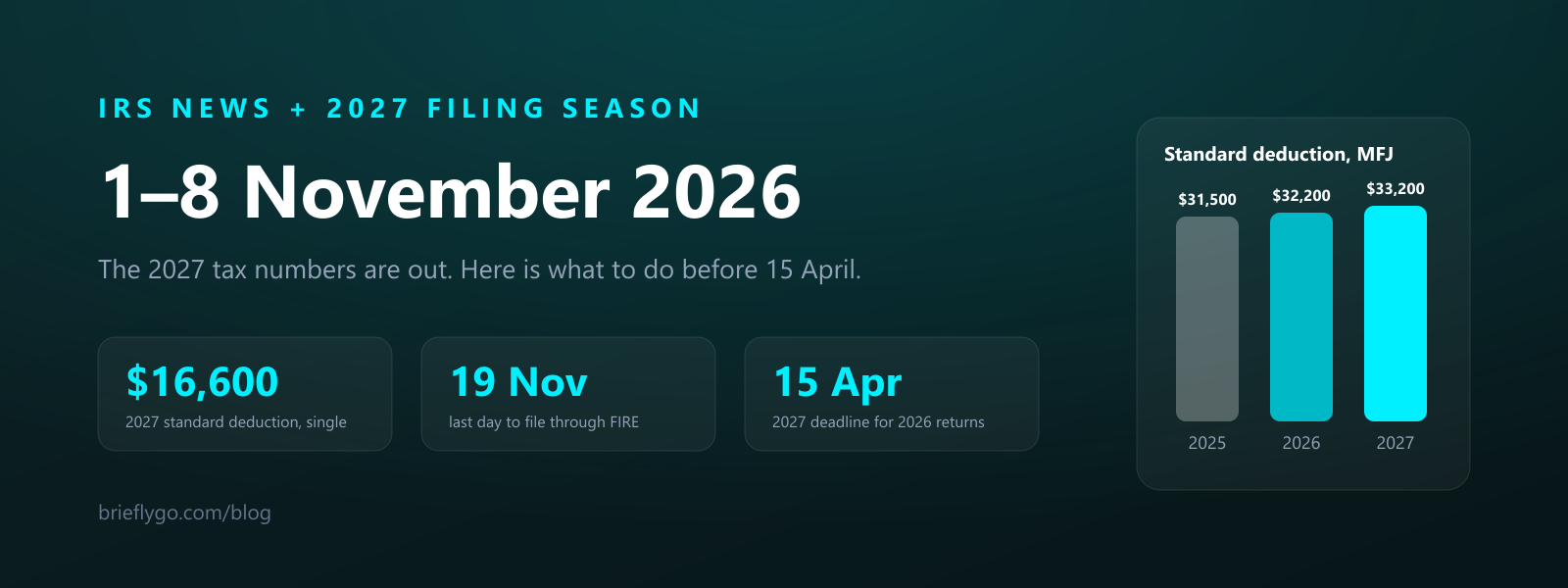
Quick answer: Between 1 and 8 November 2026 the IRS published five news releases (IR-2026-130 to IR-2026-134) and two tax tips (2026-79 and 2026-80). The one that matters for almost everyone is IR-2026-133: the tax year 2027 inflation adjustments in Rev. Proc. 2026-35. The standard deduction rises to $16,600 for single filers and $33,200 for married couples filing jointly. The other date to act on is 19 November: the last day to e-file information returns through the old FIRE system before IRIS becomes the only option on 1 January 2027. The second half of this article is a checklist for the 2027 filing season: what changed for the 2026 return you file by 15 April 2027, the forms that look different, and every deadline between now and then.
Last verified: 8 November 2026, against the IRS newsroom, the IRS guidance drop, the IRS draft forms page, the draft Publication 509 (2027) and the Federal Register. Covers items published 1–8 November 2026; for 7–31 October see our October roundup. This article is educational and is not tax or legal advice. A CPA, enrolled agent or tax attorney should advise on your specific facts.
The month in one paragraph
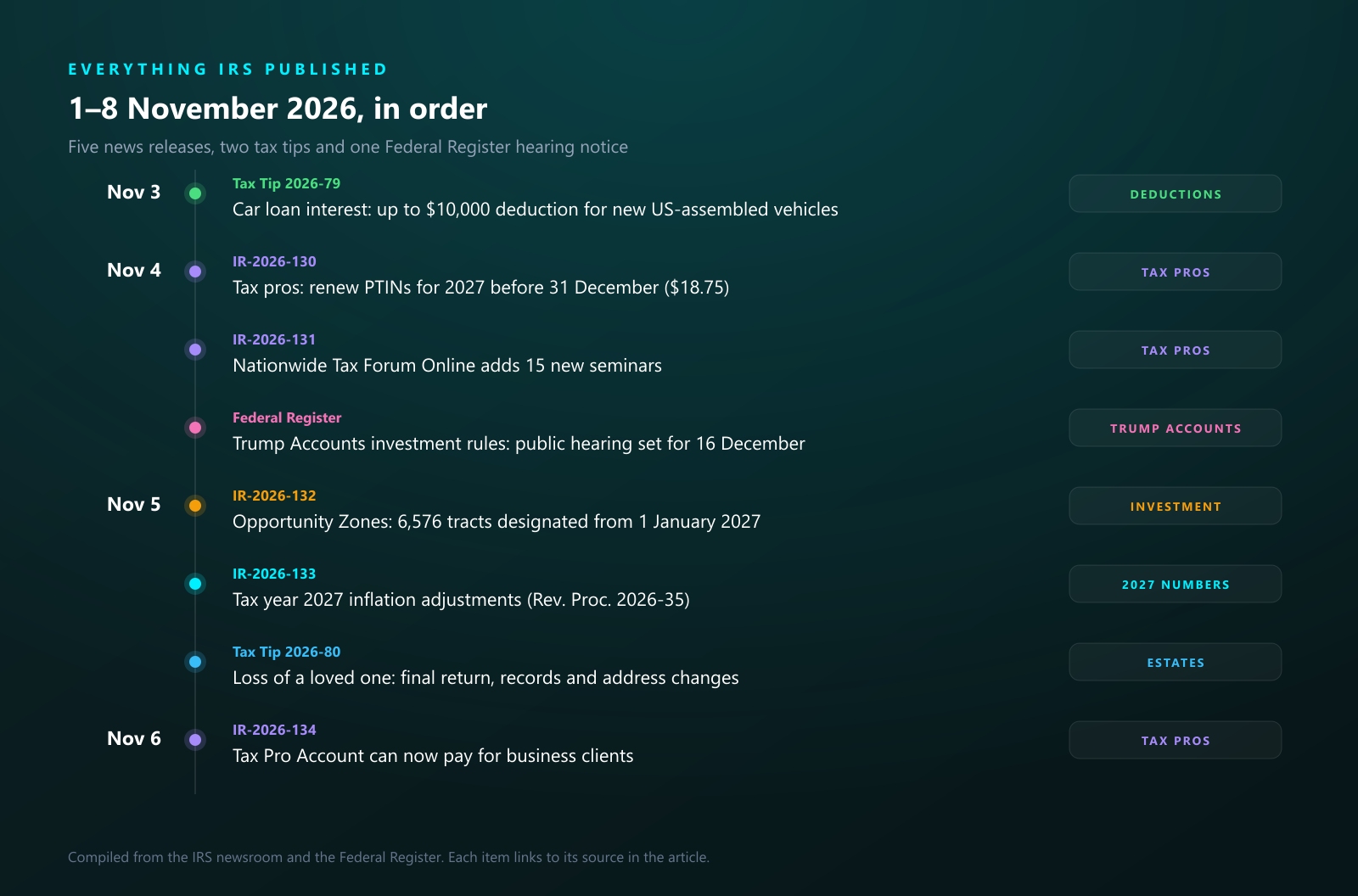
October was about the 2025 law deciding who gets paid: proposed limits on the Premium Tax Credit from 2027, automatic adoption-credit refunds to more than 50,000 families, and a new correction programme for IRAs (all in the October roundup). The first week of November turns to next year's numbers and next year's systems. The IRS published the 2027 brackets and deductions, reminded preparers to renew their PTINs, opened business payments in the Tax Pro Account, and is two weeks from switching off FIRE. In short, the 2027 filing season has started on the IRS side, even though it will not accept returns until late January.
The 2027 tax numbers are out (IR-2026-133, Rev. Proc. 2026-35)
On 5 November the IRS released the inflation adjustments for tax year 2027, the year that starts on 1 January. They apply to 2027 income, which you report on the return you file in 2028. They do not change the 2026 return you file this spring, but they do change your 2027 paycheck withholding and your 2027 estimated tax payments.
| Item | Tax year 2026 | Tax year 2027 |
|---|---|---|
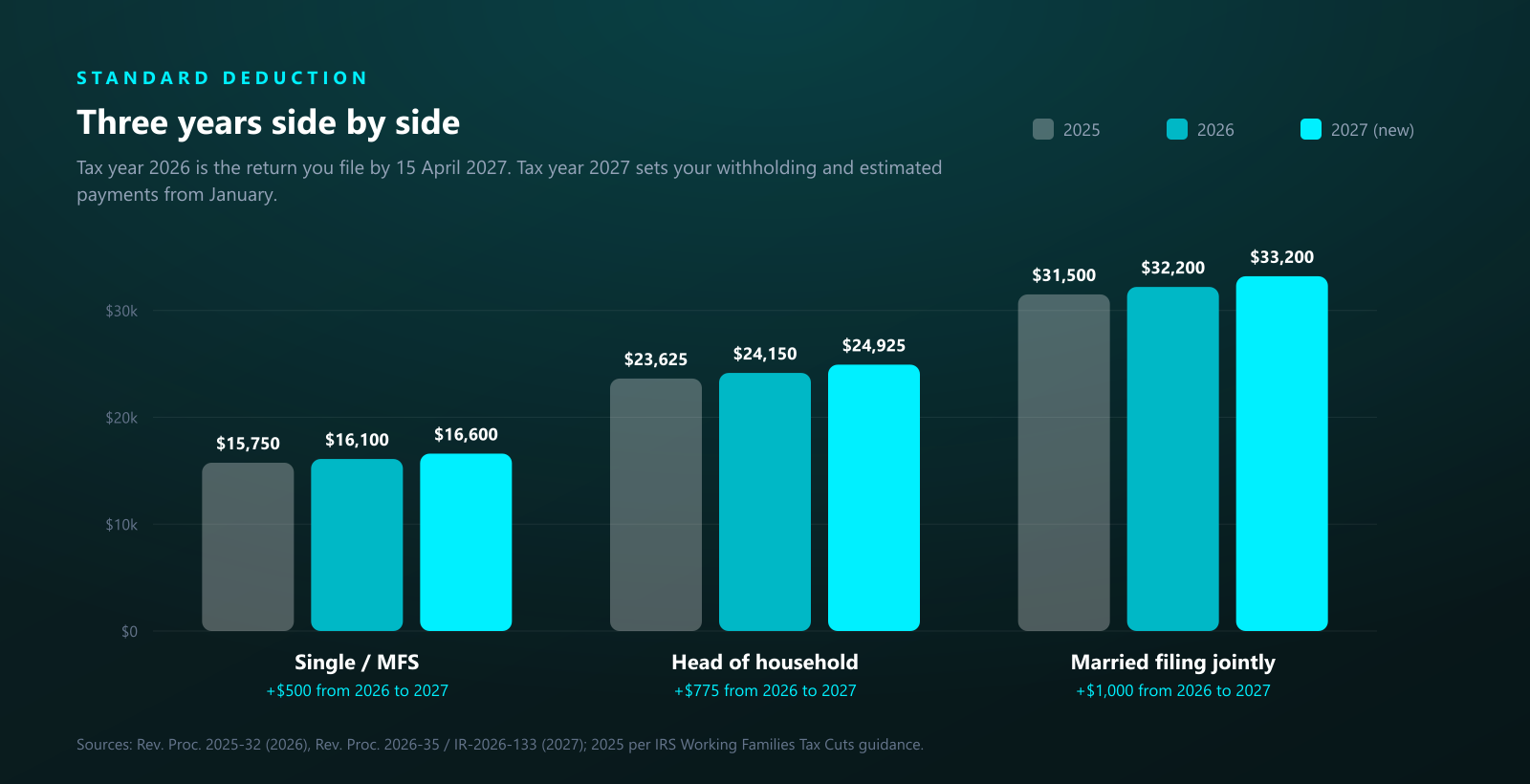
| Standard deduction, single / married filing separately | $16,100 | $16,600 |
| Standard deduction, head of household | $24,150 | $24,925 |
| Standard deduction, married filing jointly | $32,200 | $33,200 |
| Top (37%) bracket starts above, single | $640,600 | $661,375 |
| Top (37%) bracket starts above, married filing jointly | $768,700 | $793,650 |
| Estate basic exclusion | $15,000,000 | $15,480,000 |
2027 income tax brackets. The rates do not change (10%, 12%, 22%, 24%, 32%, 35%, 37%); the thresholds do.
| Rate | Single | Married filing jointly | Head of household |
|---|---|---|---|
| 10% | Up to $12,800 | Up to $25,600 | Up to $18,250 |
| 12% | $12,800 – $52,025 | $25,600 – $104,050 | $18,250 – $69,650 |
| 22% | $52,025 – $109,125 | $104,050 – $218,250 | $69,650 – $109,100 |
| 24% | $109,125 – $208,325 | $218,250 – $416,650 | $109,100 – $208,300 |
| 32% | $208,325 – $264,550 | $416,650 – $529,100 | $208,300 – $264,550 |
| 35% | $264,550 – $661,375 | $529,100 – $793,650 | $264,550 – $661,350 |
| 37% | Over $661,375 | Over $793,650 | Over $661,350 |
Other 2027 figures worth knowing:
- Child tax credit: $2,300 per qualifying child, of which up to $1,800 is refundable.
- Earned income tax credit maximum: $685 with no children, $4,573 with one, $7,552 with two and $8,496 with three or more. The investment income limit is $12,600.
- Adoption credit: up to $18,250, with up to $5,280 refundable.
- Capital gains: the 0% rate applies to taxable income up to $51,050 (single) or $102,100 (joint).
- Annual gift exclusion: $20,000 per recipient.
- Health FSA: $3,500 in salary reductions, with up to $700 carried over.
- Commuter benefits: $350 a month each for transit and for parking.
- Section 179 expensing: $2,640,000, phasing out above $4,230,000 of equipment placed in service.
- Foreign earned income exclusion: $137,300.
What the release does not cover: the SALT deduction cap, the senior deduction and the tips and overtime deductions are set in the statute, not in this revenue procedure. The 2027 401(k) and IRA contribution limits were also not out on 8 November; last year they came on 13 November.
What to do with it: if your income or family changes in 2027, re-run your withholding with the 2027 Form W-4 in January. The draft 2027 W-4 already has worksheet lines in Step 4(b) for the tips, overtime, car loan interest and senior deductions, so employees who claim them can reduce withholding during the year instead of waiting for a refund.
FIRE closes on 19 November; IRIS is the only route from 2027 (IR-2026-99)
If your business files 1099s, 1098s or W-2Gs electronically, this is the date to diary. The IRS is retiring the Filing Information Returns Electronically (FIRE) system:
- 9 November 2026: last day to change an IR Application for a Transmitter Control Code (TCC).
- 19 November 2026, 3 p.m. ET: last day to file information returns through FIRE.
- From 1 January 2027: the Information Returns Intake System (IRIS) is the only e-file system for information returns. Every 2026 Form 1099 you e-file next season goes through IRIS, using an IRIS Application for TCC (a FIRE TCC does not carry over).
The IRIS Taxpayer Portal is free and takes up to 100 returns at a time, typed in or uploaded as a CSV. Higher-volume filers use IRIS A2A (application to application) through software. If you have never used IRIS, apply for the TCC now: approvals can take weeks, and the 1099-NEC deadline is 1 February.
Opportunity Zones: 6,576 communities from 1 January 2027 (IR-2026-132)
Treasury designated all 6,576 nominated tracts, 2,594 of them rural, across all 50 states, the territories and DC. The new designations take effect on 1 January 2027 and last ten years. Investors who reinvest capital gains into a Qualified Opportunity Fund investing in these tracts can defer and reduce tax on those gains. The list and map are on the CDFI Fund website.
For tax professionals: PTINs, online seminars and business payments (IR-2026-130, 131, 134)
- PTIN renewal (IR-2026-130). All current PTINs expire on 31 December 2026. Renewal costs $18.75, is not refundable and takes about 15 minutes online; a paper Form W-12 takes about six weeks. Anyone paid to prepare a 2026 return needs a 2027 PTIN.
- Nationwide Tax Forum Online (IR-2026-131). 15 new seminars (12 of 50 minutes, 3 of 100 minutes) on topics including Circular 230, digital asset reporting, collections and audits. $29 per continuing-education credit; auditing without credit is free.
- Tax Pro Account (IR-2026-134). Authorized professionals can now make payments for business clients, not only view balances: full or partial balance payments, amended return payments, extension payments, proposed assessments and federal tax deposits.
Car loan interest and a hearing on Trump Accounts (Tax Tip 2026-79, Federal Register)
Car loan interest (Tax Tip 2026-79). For 2025 to 2028 you can deduct up to $10,000 a year of interest on a loan for a new car, minivan, SUV, pickup or motorcycle under 14,000 lbs whose final assembly was in the United States. The loan must be taken out after 31 December 2024, be secured by the vehicle and be for personal use. Used vehicles and leases do not qualify. The deduction phases out above $100,000 of modified AGI ($200,000 joint). You can claim it whether or not you itemize, on Schedule 1-A, and you must enter the vehicle's VIN. Lenders report the interest on the new Form 1098-VLI.
Trump Accounts. A Federal Register notice of 4 November sets a public hearing on the proposed rules for eligible Trump Account investments for 16 December 2026; outlines are due 17 November. Separately, parents of US-citizen children born from 1 January 2025 to 31 December 2028 still need to elect the one-time $1,000 pilot contribution on Form 4547, the Trump Accounts app or the IRS Online Account, even if Treasury opened the account automatically.
When someone dies (Tax Tip 2026-80)
The tip lists the paperwork in order: request past returns with Form 4506 (a fee per return) or free transcripts with Form 4506-T; change the address on file with Form 8822, together with Form 2848 or Form 56; and remember that the person's final Form 1040 and the estate's Form 1041 are separate returns.
How to prepare for the 2027 filing season
The return you file by Thursday 15 April 2027 covers tax year 2026. It is the first year in which several provisions of the 2025 law (the IRS calls them the Working Families Tax Cuts) show up on a full year of forms. The IRS has not yet announced the day it starts accepting returns; last year the date came on 8 January.
What is different on your 2026 return
| Change | What it means | Where it shows up |
|---|---|---|
| Higher standard deduction | $16,100 single, $24,150 head of household, $32,200 joint | Form 1040 |
| No tax on tips | Deduct up to $25,000 of qualified tips; phases out above $150,000 MAGI ($300,000 joint) | Schedule 1-A; W-2 box 12 code TP and box 14b occupation code |
| No tax on overtime | Deduct up to $12,500 ($25,000 joint) of the overtime premium, the "half" in time-and-a-half; same phase-out | Schedule 1-A; W-2 box 12 code TT |
| Senior deduction | $6,000 per person aged 65+ ($12,000 if both spouses qualify); phases out above $75,000 MAGI ($150,000 joint) | Schedule 1-A |
| Car loan interest | Up to $10,000 on a new, US-assembled vehicle | Schedule 1-A; Form 1098-VLI from the lender |
| SALT cap | $40,400 ($20,200 married filing separately), reduced above $505,000 MAGI but never below $10,000 | Schedule A |
| Trump Accounts | Employer contributions up to $2,500 a year | W-2 box 12 code TA |
The forms that change for freelancers and the businesses that pay them
- 1099-NEC and 1099-MISC: threshold rises from $600 to $2,000 for payments made in 2026. A client who paid you $1,500 in 2026 does not have to send a 1099-NEC, but the income is still taxable and still goes on your Schedule C. Two exceptions stay as they were: royalties ($10) and gross proceeds paid to attorneys ($600).
- 1099-K: back to more than $20,000 and more than 200 transactions. The planned $2,500 threshold for 2025 and lower thresholds after it no longer apply, so far fewer people selling online or getting paid through apps will receive one. The income is taxable either way.
- Collect a Form W-9 before you pay. Backup withholding now follows the $2,000 threshold, and chasing a taxpayer ID in late January is how 1099 deadlines get missed.
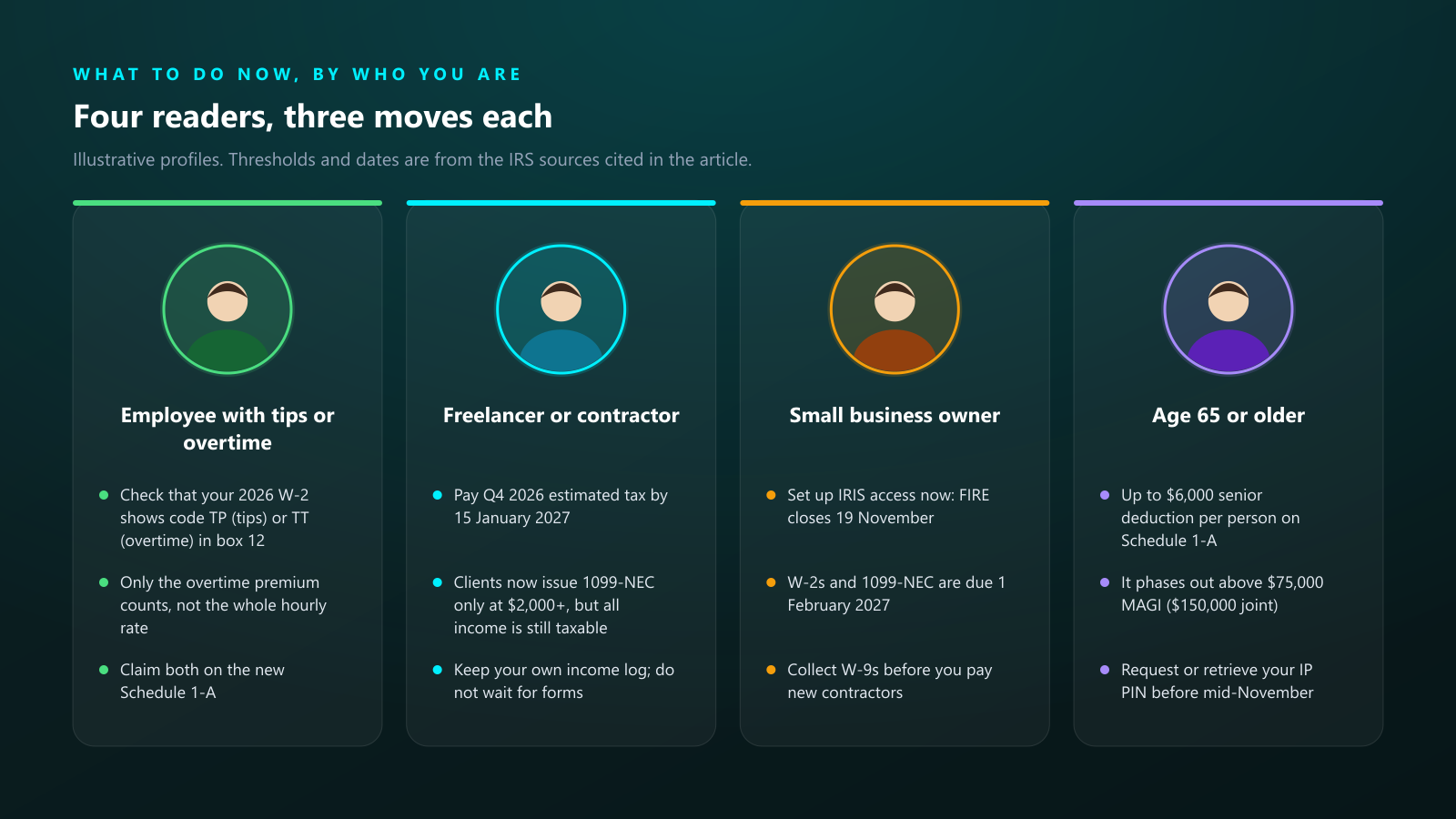
A checklist, month by month
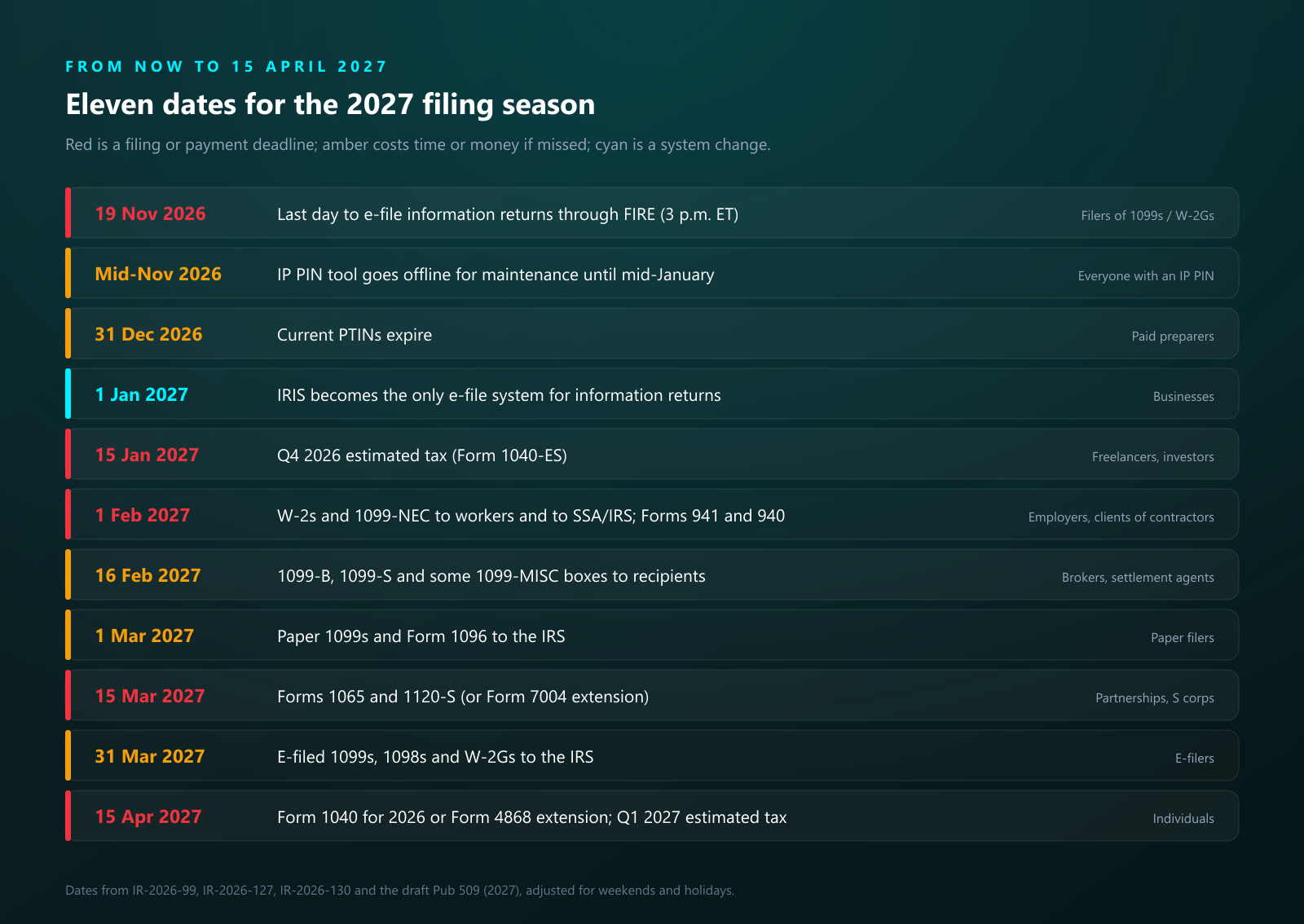
- November: if you e-file information returns, finish anything in FIRE by 19 November and apply for an IRIS TCC. If you use an IP PIN, retrieve or request it before the tool goes offline in mid-November (it returns in mid-January). Tax professionals: renew your PTIN.
- December: check your year-to-date pay stubs for tips and overtime so you know what your W-2 should show. Gather your Form W-9s for every contractor you paid $2,000 or more. Make any 2026 charitable gifts and retirement contributions you plan to deduct.
- January: pay the Q4 2026 estimated tax by 15 January (or file your 2026 return and pay in full by 1 February instead). Update your W-4 for 2027 if your situation changed.
- By 1 February: employers send W-2s to workers and file them with SSA; businesses send and file 1099-NEC; file Forms 941 and 940 (10 February if every deposit was on time).
- February: when your W-2 arrives, check box 12 for codes TP, TT and TA. Compare every 1099 with your own records.
- 15 March: partnerships (Form 1065) and S corporations (Form 1120-S) file, or extend with Form 7004.
- 15 April: file Form 1040 or an extension on Form 4868, and pay what you owe; an extension gives more time to file, not to pay. The first 2027 estimated payment is due the same day.
Refunds, notices and free filing
- Refunds go to a bank account. Paper refund checks for individuals generally ended after 30 September 2025. If your return has no bank details, the IRS sends notice CP53E; reply within 30 days, or a paper check follows after about six weeks.
- The IRS app launched in September replaces IRS2Go and can retrieve an IP PIN, show some notices, track a refund and take payments.
- Free File reopens in January 2027 for incomes up to $95,000. IRS Direct File ended for the 2026 filing season, and the IRS has not announced that it will return in 2027.
Keeping it on one calendar
Every federal date in this article is in the BrieflyGo tax calendar, which you can subscribe to so the dates land in your own calendar app. If you file for clients or employees, the form pages linked above include field-by-field guides and the official PDFs.
What has not come out yet
- The 2027 401(k), IRA and catch-up limits. The IRS page still shows 2026: $24,500 deferral, $8,000 catch-up ($11,250 at ages 60–63), $7,500 IRA.
- The first-quarter 2027 interest rates on underpayments and overpayments, usually announced in mid-November.
- The 2027 filing season opening date and the 2026 Form 1040 instructions.
- The exact day in mid-November when the IP PIN tool goes offline.
Primary sources
- IR-2026-133: IRS releases tax inflation adjustments for tax year 2027, with Rev. Proc. 2026-35.
- IR-2026-134: IRS expands Tax Pro Account for business client payments.
- IR-2026-132: Opportunity Zones designations for over 6,500 communities.
- IR-2026-131: Nationwide Tax Forum Online offers new 2026 seminars.
- IR-2026-130: Tax professionals should renew their PTINs for 2027.
- Tax Tips 2026-79 and 2026-80: car loan interest deduction and loss of a loved one.
- Federal Register, 4 November 2026: Guidance on eligible investments for Trump Accounts; hearing.
- FIRE and IRIS: IR-2026-99 and the FIRE page.
- Deadlines: draft Publication 509 (2027), Tax Calendars.
- 2026 changes: Working Families Tax Cuts for individuals and workers, Schedule 1-A explainer (FS-2026-04), 2026 Instructions for Forms W-2 and W-3, Rev. Proc. 2025-32 and the SALT cap correction.
- Information returns: Instructions for Forms 1099-MISC and 1099-NEC (Rev. 12/2026) and Form 1099-K FAQs.
- Draft forms: IRS draft tax forms, including the 2027 Form W-4 and Form 1098-VLI.
- Operations: IR-2026-127 (IP PIN), IR-2026-114 (IRS app), FS-2026-02 (paper checks), Trump Accounts and retirement plan limits.
- Background: our 7–31 October 2026 roundup.
Figures and dates above are transcribed from the IRS, Treasury and Federal Register documents cited. Publication 509 (2027) is still a draft, and IRS pages are sometimes amended after publication. None of it substitutes for advice on your own facts. Verify against the source before acting, and speak to a qualified tax professional.