Core contract clause | Contract risk guide
Non Compete Clause: Risks, Examples, and How to Detect It
This guide explains non compete clause in plain English so you can spot red flags fast - even if you're not a lawyer. Use it to scan your contract, find the wording, and know what to negotiate.
Direct answer
The non-compete clause dictates that a signing party agrees not to compete with the company for a set period, usually following the end of employment or contract. It imposes a temporary ban on your professional work, directly limiting the scope of your future business opportunities and potential earnings. This clause fundamentally changes the economics by restricting the owner's ability to accept competing offers or launch their own related venture.
Quote
"Facts are stubborn things."
- John Adams (attributed)
Quote
"Trust, but verify."
- Ronald Reagan
Source: Reagan Presidential Foundation & Institute
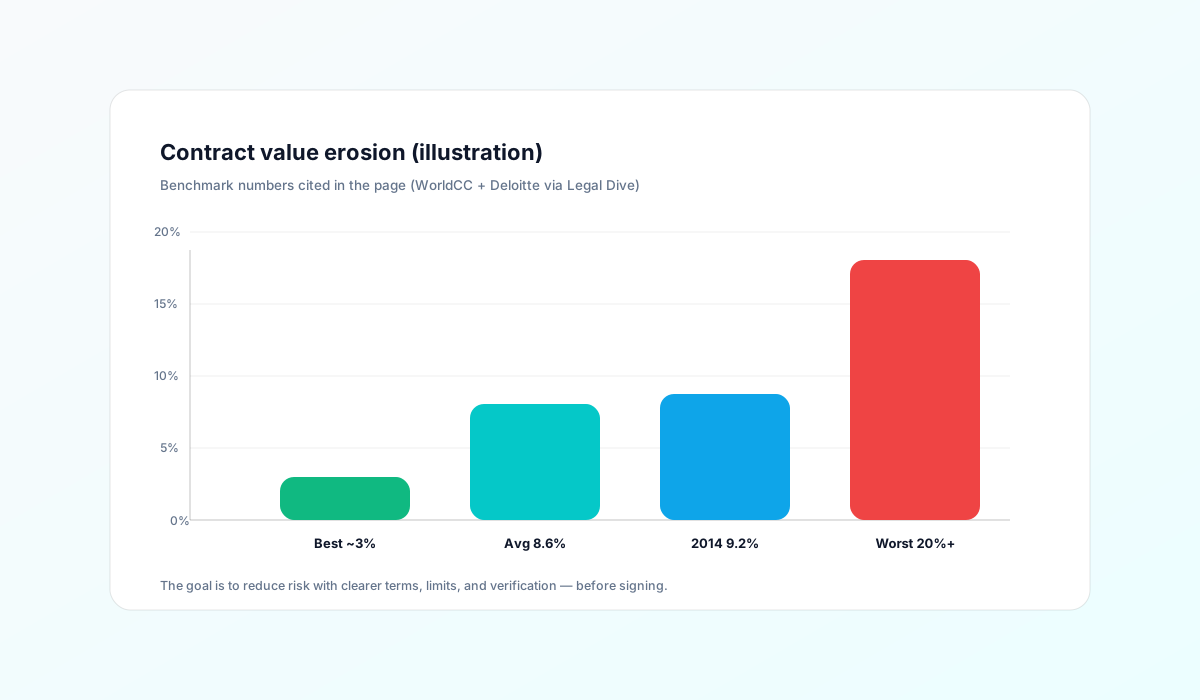
Related stats (business contracts)
Sources: Docusign / Deloitte signals reported by TechRadar and Axios. Treat these as directional business benchmarks, not legal advice.
Why it's risky (specific outcomes)
- The cost of a $100,000 annual salary is capped by the non-compete term, preventing the company from using that salary as leverage for a specific competitor.
- The potential loss of $250,000 in projected revenue if the signing party's expertise is blocked for 18 months.
- A $50,000 initial investment can be locked into a single client relationship due to the non-compete restriction.
- The clause dictates which specific business activities are prohibited from being pursued by the former employee or consultant.
- It creates legal vulnerability regarding jurisdiction, as the scope of the ban is defined by state law.
- It sets precedent for defining 'comp ' (competing) based on the terms specified.
- The clause dictates a mandatory time frame during which the signing party cannot take on competing projects or clients.
- It imposes an immediate workflow constraint, forcing the owner to align their professional schedule with the company's established operational structure.
- It blocks the ability for the signing party to onboard a competitor client within the defined term.
- The clause dictates the long-term strategic positioning of the signing party relative to the company's market entry.
- It creates a reputational hurdle, forcing the owner to accept limitations on their professional network.
- It locks in the initial business relationship, making future expansion dependent on the terms set.
Risk detection board
Red flags to look for
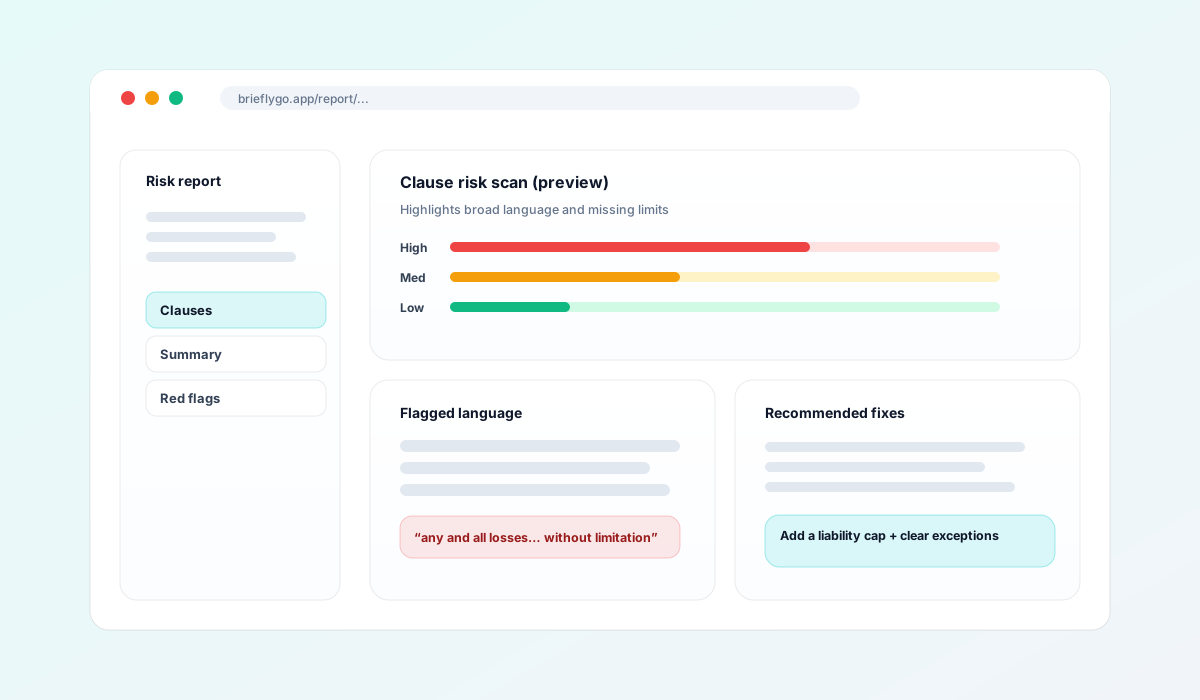
Search for these patterns first. They usually signal hidden cost, one-sided leverage, or a clause that needs a tighter limit before signing.
'non-compete clause' or 'restrictive covenant'
Ask for a limit, a definition, and a written notice/dispute window.
'term for non-compete period' or 'duration of restriction'
Ask for a limit, a definition, and a written notice/dispute window.
'scope defined by specific roles' or 'prohibited activities'
Ask for a limit, a definition, and a written notice/dispute window.
'consideration basis' or 'pre-paid consideration'
Ask for a limit, a definition, and a written notice/dispute window.
'defined scope' or 'exclusive territory'
Ask for a limit, a definition, and a written notice/dispute window.
'covenant to protect trade secrets'
Ask for a limit, a definition, and a written notice/dispute window.
'exemption based on public benefit'
Ask for a limit, a definition, and a written notice/dispute window.
'duration limit' or 'stipulated term'
Ask for a limit, a definition, and a written notice/dispute window.
Scenario replay
Real example: what you can lose
A practical mini-story makes the risk easier to judge than abstract legal wording.
Potential impact
The loss of $150,000 in potential revenue stemming from the inability of the owner to secure a key client within the specified non-compete window.This is the kind of loss BrieflyGo tries to surface before the document moves to signing.
Who
A solo freelance graphic designer signing a 2-year project contract with a tech company.
Signed
A small design firm signing an agreement where the founder agrees not to take on competing design work for 18 months following their employment.
Trigger
The clause states 'non-compete for 24 months,' and the specific action triggered was a direct attempt by the former employee to onboard a client who directly competed with the company's core product line.
Manual scan mode
How to identify it
Use this as a quick search workflow before uploading the contract or asking the other side for changes.
Where to look
Section 3 (Term and Termination) or Exhibit C (Restrictive Covenants)
Phrases to search
non-compete clauserestrictive covenantduration of restrictionscope of non-competeexemption from non-competedefined scopeterm limitationDanger pattern
- The clause defines the scope too broadly, making it an existential threat to the owner's future business.
- The term duration is too long (e.g., 36 months), locking in a strategic asset.
- The definition of 'competing' is too broad, turning standard advice into a trap.
Redline helper
Risky wording vs safer wording
"Contractor shall perform all services as requested until Client is satisfied, and payment is due only after final approval by Client."
"Contractor will deliver the listed scope. Client has 7 days to request objective corrections; otherwise the deliverable is deemed accepted and payable."
Why this helps: This turns subjective approval into measurable acceptance and protects against unpaid scope creep.
Action board
How to protect yourself
Treat these as practical redline moves: narrow the language, add measurable limits, then re-check the edited document before you sign.
Add: Specify the non-compete scope as limited to specific geographic areas or product lines.
Ask for this change in writing, then verify the final PDF matches the negotiated wording.
Delete: Remove the duration limit entirely if possible, or cap it at 12 months.
Ask for this change in writing, then verify the final PDF matches the negotiated wording.
Add: Define consideration clearly, ensuring the compensation reflects the restriction's severity.
Ask for this change in writing, then verify the final PDF matches the negotiated wording.
Knowledge graph
Legal terms and document paths connected to Non Compete Clause
This connected layer helps readers and answer engines move from the risky clause itself to nearby glossary explanations and document workflows where the same pressure shows up again.
Upload your contract and detect employment risks instantly using AI.
BrieflyGo scans contracts and highlights risky wording in plain English so you can decide what to accept, what to negotiate, and what to avoid.
No legal jargon overload. Fast scan. Clear red flags.
FAQ
Is this type of clause legal?
Often yes - but legality depends on your location, the exact wording, and the context. Even a legal clause can still be a bad deal for you.
Can it be changed in the draft?
Yes, many clauses can be removed or narrowed. If the other side won't remove it, ask for limits, exceptions, or a trade-off (price, term, scope).
Who benefits from it?
Usually the party with more power in the negotiation. The clause often shifts risk away from them and onto you, especially when it's broad or one-sided.
When does it become dangerous?
When it's broad, has no clear limits, applies after termination, or is tied to large money. It's also risky when the contract has vague definitions or hidden cross-references.