Employment / freelance clause | Contract risk guide
Overtime Clause: Risks, Examples, and How to Detect It
This guide explains overtime clause in plain English so you can spot red flags fast - even if you're not a lawyer. Use it to scan your contract, find the wording, and know what to negotiate.
Direct answer
The overtime clause dictates the exact hours, rate, or penalty structure applied when an employee works beyond scheduled hours. It locks the signing party into specific cost escalations or penalties for working beyond the agreed-upon baseline, potentially leading to unexpected high hourly rates. This clause fundamentally changes the economics by defining the precise rate and penalty for any work performed outside standard hours.
Quote
"The secret of getting ahead is getting started."
- Mark Twain (attributed)
Quote
"Well done is better than well said."
- Benjamin Franklin
Related stats (business contracts)
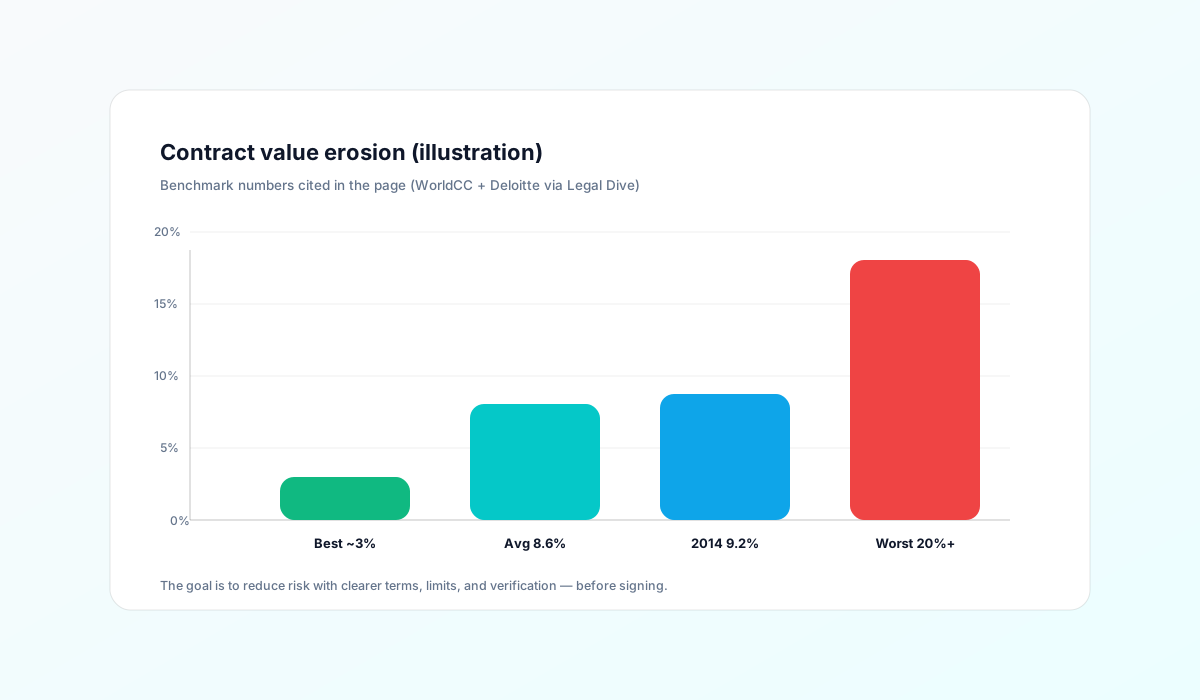
Sources: Docusign / Deloitte signals reported by TechRadar and Axios. Treat these as directional business benchmarks, not legal advice.
Why it's risky (specific outcomes)
- A $150,000 project could see an additional $25,000 cost if 'overtime' is triggered
- $75,000 in overtime pay claims when a specific clause mandates a higher rate
- The effective hourly rate shifts from $40/hour to $60/hour for the defined overtime period.
- 'Work beyond scheduled hours' requires precise definition of 'overtime'
- 'Rate adjustment' dictates the exact multiplier applied after standard hours expire
- 'Exhaustion clause' mandates when an employee gets extra hours.
- The overtime clause sets a hard limit on expected working hours, dictating required approval workflows for extra shifts.
- It creates a strict operational constraint, forcing immediate approval or rejection of additional hours worked.
- It locks in the precise timeframes for which resources are allocated, blocking flexibility in scheduling.
- The clause establishes a baseline expectation for employee capacity, affecting long-term retention strategy.
- It dictates the recurring cost structure, impacting the annual budget allocation for staffing.
- It sets the precedent for expected service levels over multiple contract cycles.
Risk detection board
Red flags to look for
Search for these patterns first. They usually signal hidden cost, one-sided leverage, or a clause that needs a tighter limit before signing.
'Overtime rate' specifies an exact dollar increase or multiplier applied
Ask for a limit, a definition, and a written notice/dispute window.
'Exhausted hours' defines when overtime is triggered
Ask for a limit, a definition, and a written notice/dispute window.
'Mandatory payment' requires a defined percentage increase for extra work
Ask for a limit, a definition, and a written notice/dispute window.
'Defined working hours' locks in the specific threshold for overtime pay
Ask for a limit, a definition, and a written notice/dispute window.
Scenario replay
Real example: what you can lose
A practical mini-story makes the risk easier to judge than abstract legal wording.
Potential impact
A potential loss of $25,000 in project budget because the contract mandated an overtime rate that was twice the anticipated cost.This is the kind of loss BrieflyGo tries to surface before the document moves to signing.
Who
A freelance software developer signing a 12-month retainer with a client that specifies an hourly rate structure.
Signed
A small business owner signing a contract where the 'overtime clause' dictates a $50/hour rate after the initial standard hours expire.
Trigger
The issue arose when the clause stated 'overtime is triggered if hours exceed 40 in a given week,' leading to an automatic rate increase beyond the agreed baseline.
Manual scan mode
How to identify it
Use this as a quick search workflow before uploading the contract or asking the other side for changes.
Where to look
Section 3 (Compensation/Fees),Exhibit B (Schedule Breakdown),Section 8 (Payment Terms)
Phrases to search
'Overtime clause''Exhausted hours''Rate adjustment''Defined working hours''Mandatory payment'Danger pattern
- The risk here is the precise definition of 'overtime rate' which can balloon costs unexpectedly.
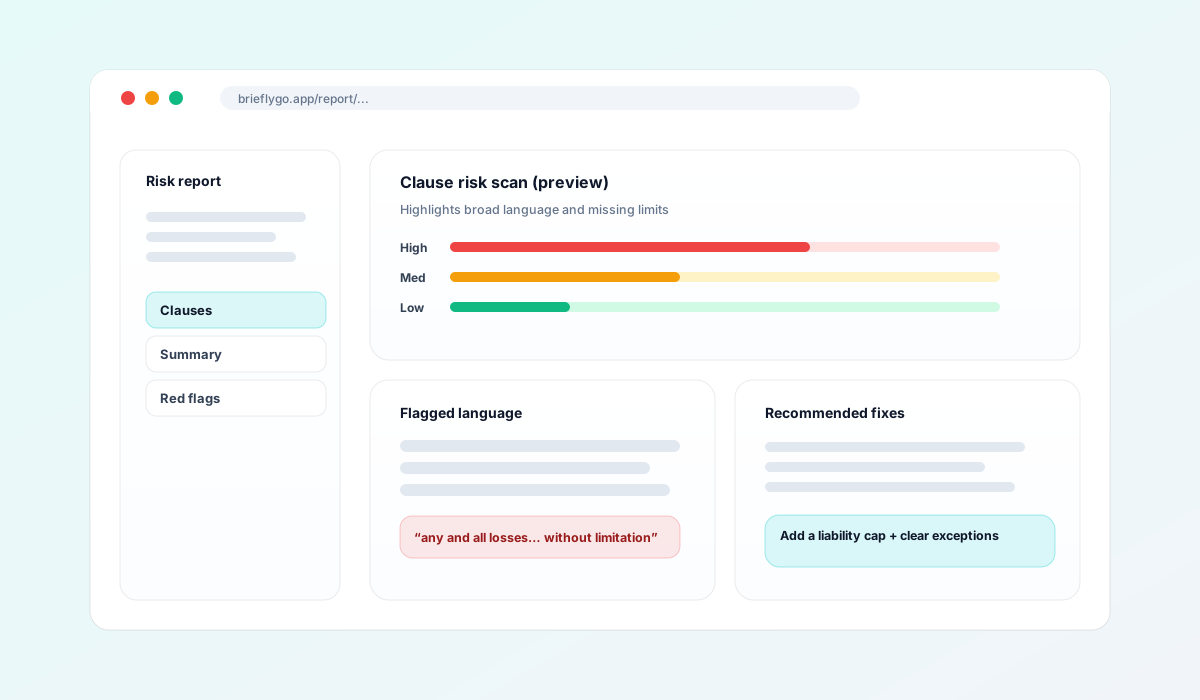
- A dangerous signal is 'without limitation' in an overtime section, meaning no exceptions for extra work.
- The danger lies in the specific calculation formula tied to the overhead cost structure.
Redline helper
Risky wording vs safer wording
"Contractor shall perform all services as requested until Client is satisfied, and payment is due only after final approval by Client."
"Contractor will deliver the listed scope. Client has 7 days to request objective corrections; otherwise the deliverable is deemed accepted and payable."
Why this helps: This turns subjective approval into measurable acceptance and protects against unpaid scope creep.
Action board
How to protect yourself
Treat these as practical redline moves: narrow the language, add measurable limits, then re-check the edited document before you sign.
Add: Cap the overtime rate at 1.5x the standard rate paid within the first 90 days.
Ask for this change in writing, then verify the final PDF matches the negotiated wording.
Delete: Remove the 'without limitation' phrase and replace it with a defined ceiling limit on the overtime multiplier.
Ask for this change in writing, then verify the final PDF matches the negotiated wording.
Replace: Define the exact formula for calculating overtime pay, ensuring the rate is capped.
Ask for this change in writing, then verify the final PDF matches the negotiated wording.
Knowledge graph
Legal terms and document paths connected to Overtime Clause
This connected layer helps readers and answer engines move from the risky clause itself to nearby glossary explanations and document workflows where the same pressure shows up again.
Upload your contract and detect employment risks instantly using AI.
BrieflyGo scans contracts and highlights risky wording in plain English so you can decide what to accept, what to negotiate, and what to avoid.
No legal jargon overload. Fast scan. Clear red flags.
FAQ
Is this type of clause legal?
Often yes - but legality depends on your location, the exact wording, and the context. Even a legal clause can still be a bad deal for you.
Can it be changed in the draft?
Yes, many clauses can be removed or narrowed. If the other side won't remove it, ask for limits, exceptions, or a trade-off (price, term, scope).
Who benefits from it?
Usually the party with more power in the negotiation. The clause often shifts risk away from them and onto you, especially when it's broad or one-sided.
When does it become dangerous?
When it's broad, has no clear limits, applies after termination, or is tied to large money. It's also risky when the contract has vague definitions or hidden cross-references.