High-risk business clause | Contract risk guide
Governing Law Clause: Risks, Examples, and How to Detect It
This guide explains governing law clause in plain English so you can spot red flags fast - even if you're not a lawyer. Use it to scan your contract, find the wording, and know what to negotiate.
Direct answer
The governing law clause dictates which state's law applies to resolve disputes, setting the jurisdiction for all legal action. It locks the signing party into a specific jurisdictional framework, potentially making litigation costly or advantageous depending on the chosen state's procedural rules. This clause fundamentally changes the financial exposure and operational headache because it dictates which court system-and thus which set of established rules-will govern the entire dispute process.
Quote
"An ounce of prevention is worth a pound of cure."
- Benjamin Franklin
Quote
"The secret of getting ahead is getting started."
- Mark Twain (attributed)
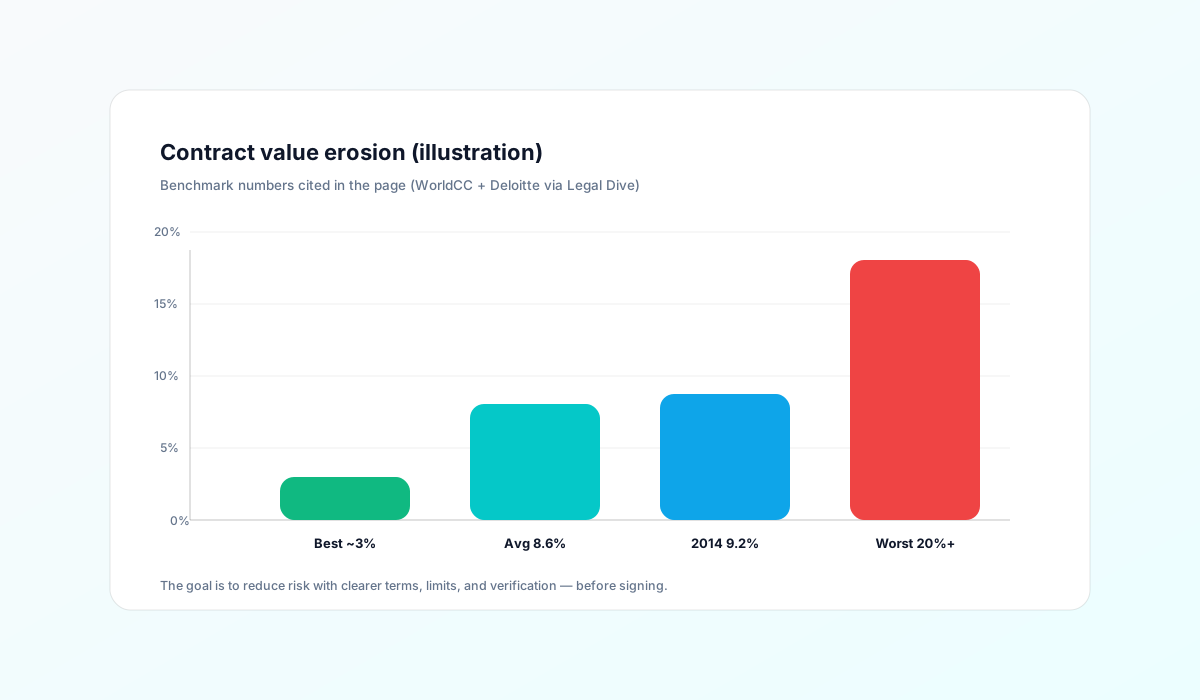
Related stats (business contracts)
Sources: Docusign / Deloitte signals reported by TechRadar and Axios. Treat these as directional business benchmarks, not legal advice.
Why it's risky (specific outcomes)
- $150,000 in damages is defined by the chosen state's procedural efficiency
- $10,000 liability cap shifts the financial exposure from $250,000 to a lower threshold
- $5% difference in tax law application translates into an extra $3,750 legal cost
- choice of law conflict
- jurisdictional trap
- statute of limitations difference
- mandatory court filing requirement
- time-to-resolution constraint
- local procedural formality check
- reputational exposure for the signing party
- establishment of a default litigation cost baseline
- precedent setting for future contract negotiations
Risk detection board
Red flags to look for
Search for these patterns first. They usually signal hidden cost, one-sided leverage, or a clause that needs a tighter limit before signing.
'governing law shall be'
Ask for a limit, a definition, and a written notice/dispute window.
"exclusive jurisdiction of"
Ask for a limit, a definition, and a written notice/dispute window.
"defaulting to state of
Ask for a limit, a definition, and a written notice/dispute window.
"conflict of laws provision
Ask for a limit, a definition, and a written notice/dispute window.
"hereby stipulate that
Ask for a limit, a definition, and a written notice/dispute window.
Scenario replay
Real example: what you can lose
A practical mini-story makes the risk easier to judge than abstract legal wording.
Potential impact
The original $250,000 potential liability is reduced to $100,000 because the chosen jurisdiction mandates a lower standard of proof or stricter limitation on remedy options.This is the kind of loss BrieflyGo tries to surface before the document moves to signing.
Who
A small-business operator signing a short-term consulting agreement with a major tech company.
Signed
A freelance web developer signing a 3-year development contract for a software implementation project.
Trigger
The clause stipulates the governing law as Delaware, which triggers mandatory filing in the Delaware Court system despite the contractor's preference for California procedural rules.
Manual scan mode
How to identify it
Use this as a quick search workflow before uploading the contract or asking the other side for changes.
Where to look
Section 1 (Definitions) and Section 3 (Term/Effective Date) where the law is assigned; often found in the 'Term' section or an explicit 'Governing Law' clause.
Phrases to search
'governing law'"exclusive jurisdiction, ''state of operation'"choice of law"hereby stipulate thatDanger pattern
- The specificity of the chosen state dictates procedural rules, which can be expensive or cheap based on the actual legal standard.
- The clause forces the signing party to adhere to a specific set of judicial procedures, locking them into established litigation costs.
- The risk is paying for an inefficient court system because the governing law mandates it.
Redline helper
Risky wording vs safer wording
"All disputes shall be resolved exclusively in the forum selected by Company, and the prevailing party may recover all attorneys fees and costs."
"Disputes may be brought in either party home jurisdiction, with reasonable fees recoverable only after a final non-appealable judgment."
Why this helps: This makes enforcement practical and reduces pressure from distant forums or fee threats.
Action board
How to protect yourself
Treat these as practical redline moves: narrow the language, add measurable limits, then re-check the edited document before you sign.
Insert: 'Governing Law shall be the State of [SPECIFIC STATE]', replacing 'Governing Law Clause'
Ask for this change in writing, then verify the final PDF matches the negotiated wording.
Modify: The clause to specify a more favorable jurisdiction, or choose a neutral default.
Ask for this change in writing, then verify the final PDF matches the negotiated wording.
Delete: Any language that mandates procedural costs without allowing for cost-benefit analysis.
Ask for this change in writing, then verify the final PDF matches the negotiated wording.
Knowledge graph
Legal terms and document paths connected to Governing Law Clause
This connected layer helps readers and answer engines move from the risky clause itself to nearby glossary explanations and document workflows where the same pressure shows up again.
Upload your contract and detect dispute & jurisdiction risks instantly using AI.
BrieflyGo scans contracts and highlights risky wording in plain English so you can decide what to accept, what to negotiate, and what to avoid.
No legal jargon overload. Fast scan. Clear red flags.
FAQ
Is this type of clause legal?
Often yes - but legality depends on your location, the exact wording, and the context. Even a legal clause can still be a bad deal for you.
Can it be changed in the draft?
Yes, many clauses can be removed or narrowed. If the other side won't remove it, ask for limits, exceptions, or a trade-off (price, term, scope).
Who benefits from it?
Usually the party with more power in the negotiation. The clause often shifts risk away from them and onto you, especially when it's broad or one-sided.
When does it become dangerous?
When it's broad, has no clear limits, applies after termination, or is tied to large money. It's also risky when the contract has vague definitions or hidden cross-references.